
 发布日期:2019-05-28 15:03:48
 阅读:
阅读:
On the evening of May 26, at the invitation of the Center for Innovation and Strategic Human Resources Management, Dr. He, Associate Professor of the Indiana State University Scott College of Business gave an academic lecture entitled New Trends in Human Resources Management in theUnited States(1): Evidence-based Human Resources Management in the conference room 704 of Gongshang Building of Jiangxi University of Finance and Economics. The academic lecture was also the theme of the series of academic activities of the 40th anniversary of the founding of our college. Our teaching and research personnel and postgraduate students participated in the lecture. The lecture was hosted by Professor Jie Yang, Director of the Center for Innovation and Strategic Human Resource Management.
Dr. He first talked about Google's Oxygen Plan,which collects and analyses 10,000 data such as company assessment results,team performance, employee interviews and opinion surveys, and summarizes the eight capabilities of Google executives. On this basis, Dr. He deduced the specific process of Evidence-based Human Resource Management (EBHR). Then, Dr.He described four main sources of evidence that EBHR relies on: managers' experience and judgment, existing data of enterprises, available scientific research evidence and stakeholders' views.
After the lecture, our teaching and research personnel and postgraduate students asked questions and exchanged their views on evidence-based human resources management. Finally, Dr. He concluded that EBHR is a sort of management philosophy and a working method. Managers and human resources practitioners need to develop their own EBHR skills, overcome personal and organizational barriers, and use EBHR principles to guide their work.
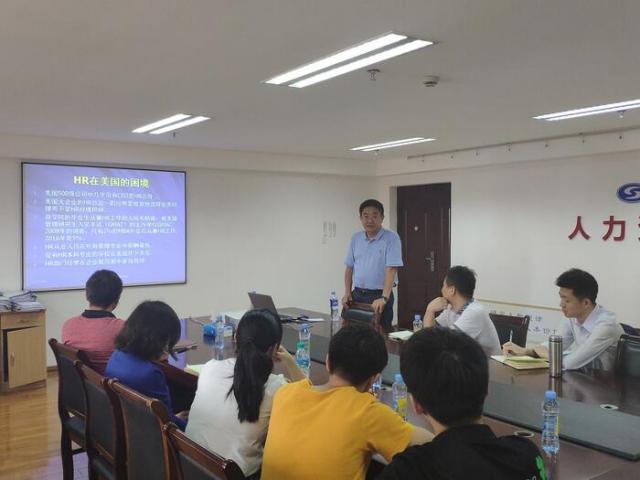
On the afternoon of May 27, Dr. He , Associate Professor of the Indiana State University Scott College of Business gave an academic lecture entitled New Trends in Human Resources Management in the United States(2): Agile Human Resources Management in the conference room 704 of Gongshang Building of Jiangxi University of Finance and Economics. Our teaching and research personnel and postgraduate students participated in the lecture. The lecture was hosted by Professor Jie Yang, Director of the Center for Innovation and Strategic Human Resource Management.
Dr. He first talked about the plight of human resources management in the United States. Then, Dr. He talked about the meaning of Agile Human Resource Management and the practice of Agile Human Resource Management from the aspects of performance appraisal, team building, compensation and learning training.
After the lecture, our teaching and research personnel and postgraduate students shared their views on related issues with Dr. He .Finally, Dr. He concluded that agile human resource management is to constantly adjust and update the main business content and process of human resource management from the reality of enterprise operation and environmental change, and to adapt flexibly to changes in enterprise strategy and objectives.
On the afternoon of May 28, Dr. He, Associate Professor of the Indiana State University Scott College of Business gave an academic lecture entitled New Trends in Human Resources Management in the United States(3): Beyond Competency Model in the conference room 704 of Gongshang Building of Jiangxi University of Finance and Economics. Our teaching and research personnel and postgraduate students participated in the lecture. The lecture was hosted by Professor Jie Yang, Director of the Center for Innovation and Strategic Human Resource Management.
Dr. He first reviewed the competency model, and described the definition, characteristics and application of the competency model. Then,Dr. He specifically analyzed the limitations of the competency model. Then, Dr. He analyzed the potential of selecting senior managers, including self-motivation, curiosity, insight and so on.
After the lecture, our teaching and research personnel and postgraduate students shared their views on related issues with Dr. He. Finally, Dr. He concluded that static competency model can not meet the dynamic demand for leadership in the era of complex and changeable situations. In selecting senior managers, more attention should be paid to the potential of candidates and their matching with leadership context.

